
Why does clay soil matter so much here?
The Colorado Geological Survey calls expansive soil Colorado's most significant geologic hazard. These soils hold a clay, often called bentonite, that soaks up water and swells. When it dries, it shrinks. The survey says swelling causes nearly all the damage in Colorado.
That damage shows up as cracked driveways, sidewalks and basement floors, and in worse cases as cracked walls and other structural damage. The survey says most homes and roads in the state sit in areas with clay that may expand. The plains and valley sides where most people live are where these soft, clay-rich rocks tend to be.
Landscaping can make it better or worse. The survey names poor surface drainage, water ponding near a foundation, and plants next to the foundation where irrigation soaks in as things that make the problem worse. Each of those is a yard decision.
Clay is also slow to drain. CSU Extension says soils with more than 20 percent clay have small pores, so water moves slowly or not at all. That is why puddles linger after a storm.
How much should the ground slope away from the house?
Boulder County's residential plan checklist gives a clear number. Lots must be graded so surface water drains away from foundation walls, and the ground must fall at least 6 inches within the first 10 feet. Your town may use similar wording, so ask your building department.
Roof water counts too. The same checklist says roof water must be collected and let out at least 5 feet from the foundation. Gutters, downspouts and downspout extensions meet that rule. CSU Extension adds a plain warning: do not remove downspout extensions to water flower beds near the house.
New landscaping can undo good grading without anyone meaning to. A raised bed against the wall, a patio that tips toward the house or a thick layer of mulch piled high can all send water the wrong way. Check the grade before and after any project, and fill low spots that hold water near the house. Make sure the water you move does not end up on a neighbor's lot.
- Ground falls at least 6 inches in the first 10 feet.
- Downspouts let out at least 5 feet from the foundation.
- Patios and paths slope away from the house.
- No low spots that hold water near the walls.
- Runoff goes somewhere safe, not to the neighbor.
What can I plant near the foundation?
CSU Extension's guide to expansive soils says to keep plants at least 5 feet from the foundation unless they need very little water. Keep trees at least 15 feet away. Do not let sprinklers spray closer than 5 feet from the foundation, and water near the house with care.
CSU also says low-water ground covers and mulch near the house help even out swings in soil moisture. Our firewise guide covers what to use in the first 5 feet around a home.
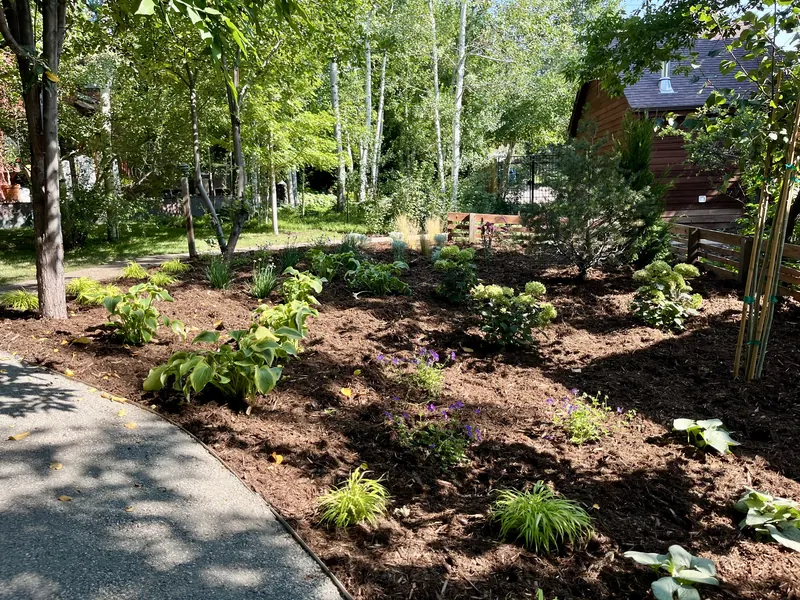
Away from the house, clay beds do better with organic matter. CSU calls compost the gold standard. For a new flower bed, it suggests 3 to 4 inches of compost mixed into the top 8 to 12 inches of soil. For a new lawn, 1 to 2 inches mixed into 6 inches. CSU warns that manure-based composts are often high in salts, and that adding gravel to soil often makes drainage worse.
Idlewild's site says it prepares soil before the first plant goes in, and its seasonal care replenishes mulch and soil and adds nutrients as needed.
Swale, dry creek bed or French drain: which do I need?
First, test how your soil drains. CSU says to dig a hole 12 inches deep and fill it with water. If it has not drained in 30 minutes, the soil has a drainage problem. If it still holds water after 24 hours, plants may struggle.
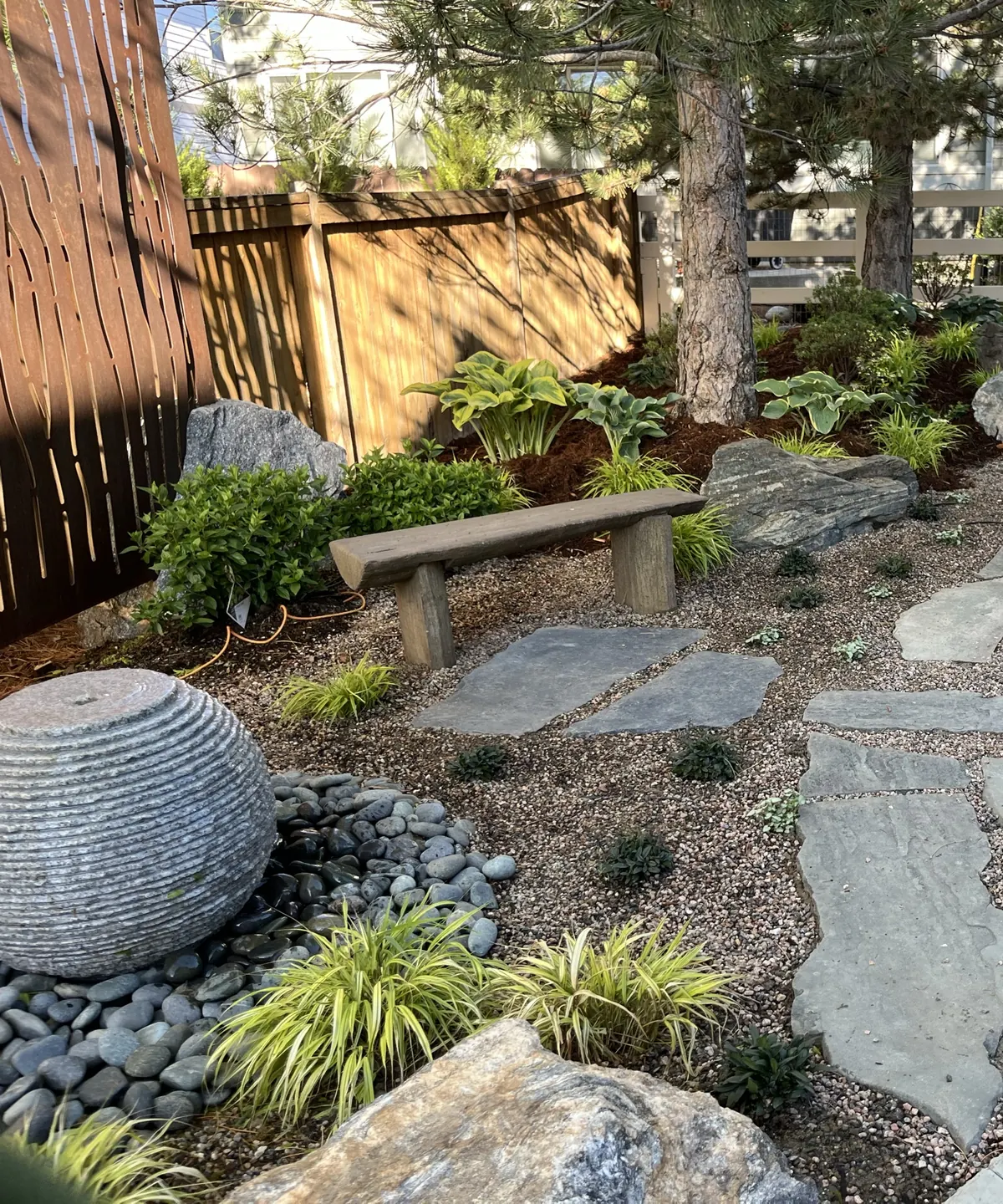
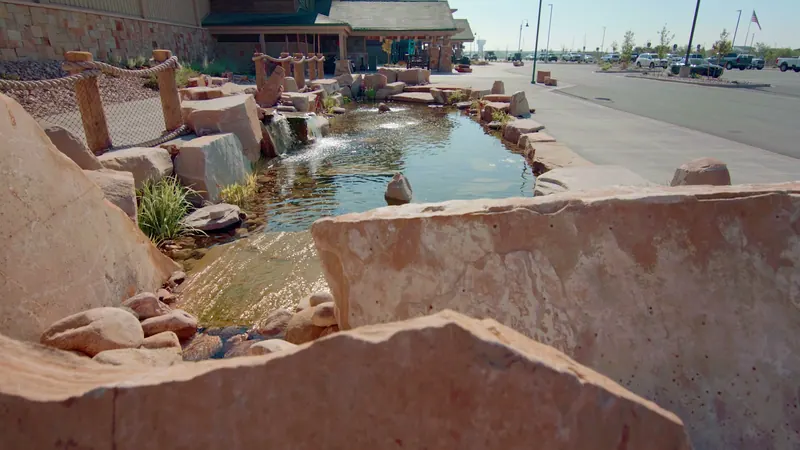
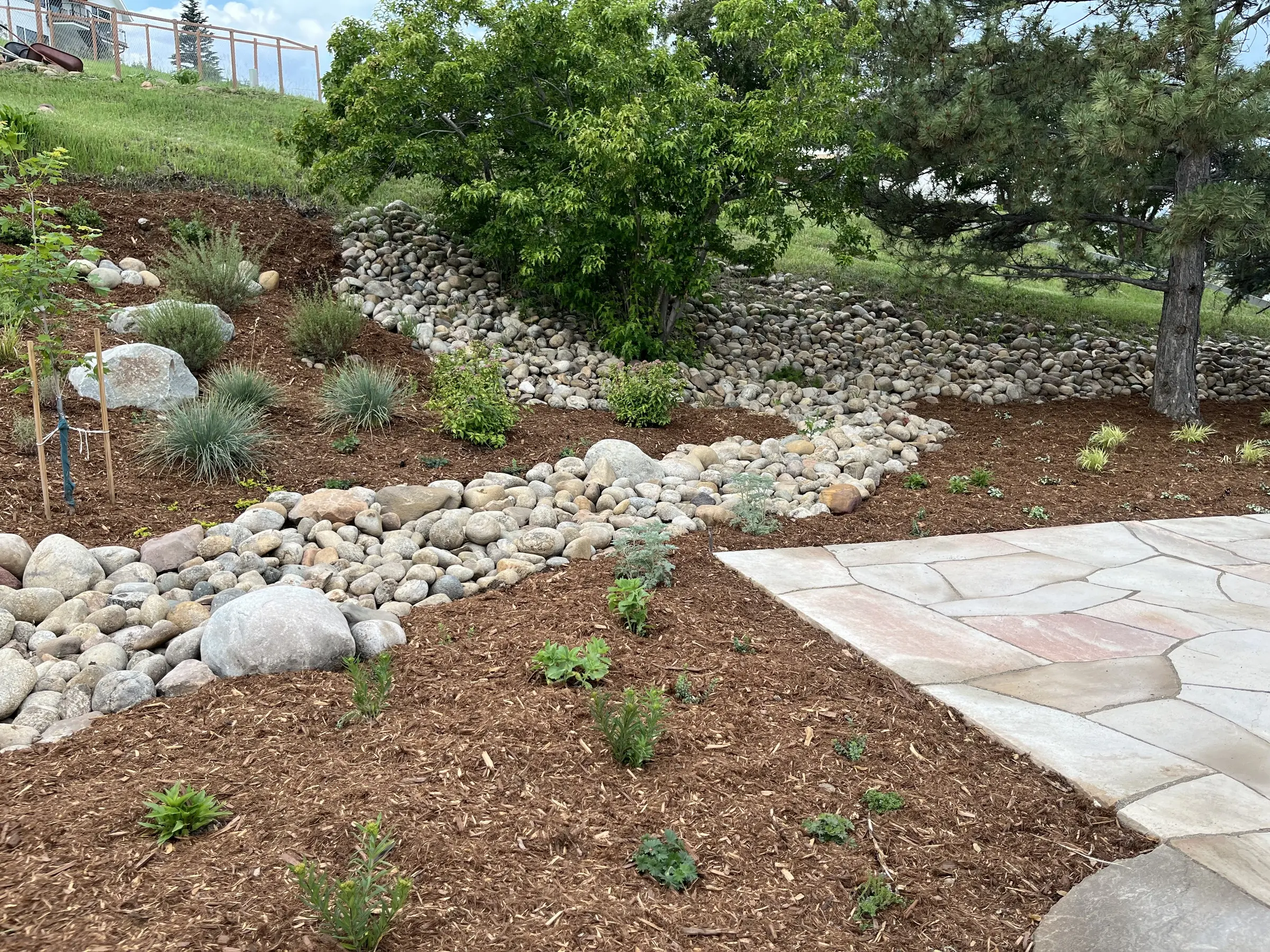
A swale is a shallow channel that carries water across the yard. CSU describes bioswales, which are planted swales, with a slope of 1 to 6 percent along their length. Lined with river rock and boulders instead of plants, a swale becomes what most people call a dry creek bed. It carries water in a storm and reads as a garden feature the rest of the year.
A rain garden is a low spot where water can soak in. CSU says to keep rain gardens at least 10 feet from buildings. In clay, keep them no more than 6 inches deep so plants don't drown. Avoid sites that drop more than 1 foot for every 12 feet.
A French drain is a trench filled with rock or gravel, usually with a pipe in the bottom. CSU says the trench must slope at least 1 to 3 percent and flow to an outlet. The rock should come up to the surface so soil does not cover the drain.
Idlewild's irrigation and drainage work includes natural drainage swales and French drains, and its designers plan grading and drainage as part of the design.
When should I call an engineer?
Landscaping can steer water away from a house. It cannot fix a foundation. The Colorado Geological Survey says only a professional soil engineer and engineering geologist should be relied on to identify swelling soil. Sticky wet soil or cracks in dry ground are warning signs, not proof.
Some work needs engineering by rule. The City of Boulder requires a soils report for all new homes. It also requires one for work that adds to or greatly changes a foundation on lots with steep slopes, sliding soils or shrink-swell soils. Those lots need engineered grading and drainage plans in most cases. Tall retaining walls have their own engineering rules.
Call an engineer before you landscape if you see cracks that keep growing in walls or floors, water in the basement after storms, or a yard that drains toward the house no matter what you do.
Before any trench is dug, call Colorado 811. State law requires you to contact 811 at least two full business days before you dig, even for small jobs. It marks public utility lines only, so private lines such as sprinkler pipe or a gas line to a grill need a separate locate.
Ways to move water in a clay yard (from CSU Extension guidance)
| Swale or dry creek bed | Rain garden | French drain | |
|---|---|---|---|
| What it is | A shallow channel, planted or lined with rock | A low planted area where water soaks in | A gravel-filled trench, usually with a pipe |
| Slope | Usually 1 to 6 percent along its length | Avoid sites that drop more than 1 foot in 12 | At least 1 to 3 percent toward an outlet |
| Where water goes | Across the surface to a safe spot | Into the soil, slowly in clay | Underground to an outlet |
| Distance from buildings | Not stated | At least 10 feet | Not stated |
| Clay note | Keep it sloped so water keeps moving | No more than 6 inches deep | Needs an outlet lower than the trench |
Questions
How far from the house should downspouts drain?
Boulder County's plan checklist says roof water must be let out at least 5 feet from the foundation. Downspout extensions meet that rule. Don't remove them to water beds by the house.
How much slope does the ground need?
Boulder County requires the ground to fall at least 6 inches within the first 10 feet from foundation walls. Check your own town's code, which may use similar wording.
Can I plant shrubs right against the house?
CSU suggests keeping plants at least 5 feet away unless they need very little water, and trees at least 15 feet away. Keep sprinkler spray 5 feet back too.
Can I tell if I have expansive soil by looking?
Not for sure. The Colorado Geological Survey says cracks and sticky soil are warning signs, but only a soil engineer and engineering geologist should be relied on to identify it.
Do I need to call 811 to dig a drain or plant a tree?
Yes. Colorado 811 says you must contact it at least two full business days before digging, no matter how shallow. It does not mark private lines such as sprinklers.
Should a rain garden go by the downspout?
Only if that spot is far enough out. CSU says to keep rain gardens at least 10 feet from buildings, and no deeper than 6 inches in clay soil.
Sources 8
- Expansive Soil and Rock (Colorado Geological Survey)
- Expansive Soils (PlantTalk Colorado 1617, CSU Extension)
- Soil Drainage (CSU Extension)
- Choosing a Soil Amendment (CSU Extension)
- Rain Gardens and Bioswales (Landscape for Life, Colorado State University)
- Residential Plan Checklist B24 (Boulder County)
- Residential Building Permit Guide (City of Boulder)
- Homeowners (Colorado 811)