

Longmont irrigation from a Longmont company
Because our office is in Longmont, a repair visit or a fall blowout here is a short drive. Every system starts with a look at what grows where, the sun and shade, the slope and the soil. Plants with the same water needs share a valve, and drip and spray heads never share a zone.
For a new Longmont design, irrigation is planned with the planting. For an existing yard, we give an estimate that covers the work. Drainage is part of the job too, from planted swales to French drains.
Watering Longmont clay in short cycles
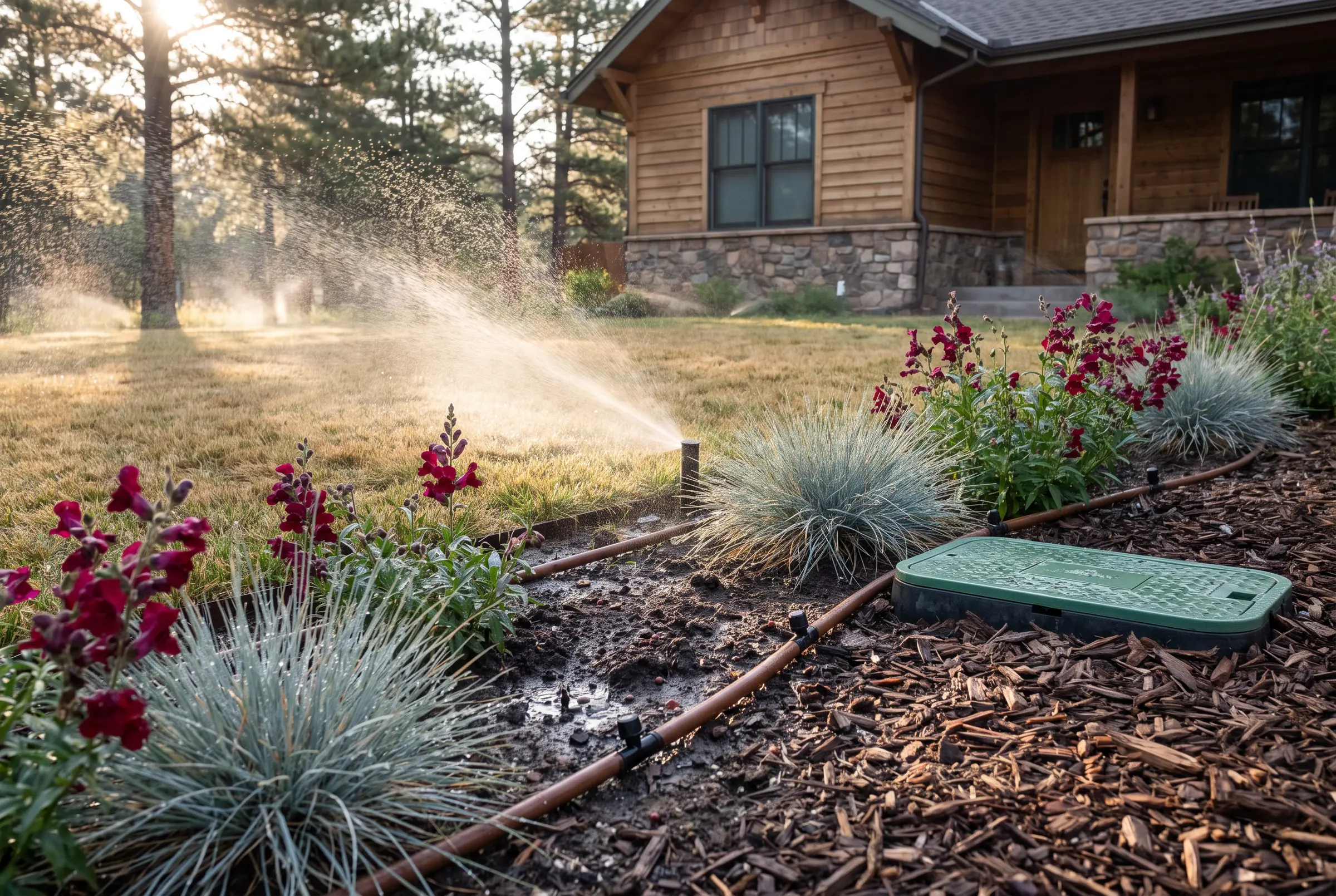
Longmont's clay soils take in water slowly, the city notes. A long run on a lawn zone puts water down faster than clay can soak it up, and the rest runs into the gutter. The city's answer is to split each run into shorter cycles with time between them.
Its example: instead of one 20-minute run, use three 6-minute cycles or two 10-minute cycles, about an hour apart, and adjust until no water runs off. A modern controller can do this on its own. Resource Central's Slow the Flow assessments, offered to Longmont customers, give you a watering schedule built for your yard and your system.
Backflow rules for Longmont irrigation
Longmont treats irrigation tied to the public water supply as a high health risk. Irrigation has to be protected by a backflow assembly rated for high-hazard cross-connections. Under state rules, double check valve assemblies (DCVAs) are no longer approved for irrigation.
If an older DCVA fails its test, the city gives two paths. Replace it with a reduced pressure (RP) assembly within 60 days, or repair it and swap in an RP within two years. New installs must be the reduced pressure type, with case-by-case exceptions.
Certified backflow testers check each assembly every year by the property's due date, in a window that runs April through September. Assemblies must also be tested after they are installed, repaired or moved. Single-family homes with dedicated irrigation lines may need these controls, so ask the city about yours.
Longmont rebates for irrigation upgrades
The City of Longmont rebates several irrigation parts for its water customers. Apply within 45 days of purchase, with proof of purchase. Used or refurbished equipment doesn't qualify. The fine print matters:
- Weather-based controllers must run an in-ground system. A WaterSense add-on can qualify an existing controller.
- Rotary nozzles qualify in sets of three or more. Rotor heads, rotor nozzles and pressure-reducing spray heads don't.
- Drip parts qualify only when they convert lawn zones to drip, not when drip goes in with a brand-new system.
- Flow sensors must connect to a WaterSense controller, and soil moisture sensors must work with the controller on a permanent system.
- Spigot timers with an automatic shutoff are for watering that isn't tied to an in-ground system.
Watering during Longmont's mild drought response
City Council moved Longmont to a Mild Drought Response in May 2026, and the level was unchanged as of November. There are no mandatory limits for residents at this level. The city asks for about 10 percent less use, with watering no more than three times a week and only between 6 p.m. and 10 a.m.
Trees need care when it stays dry. The city suggests hand-watering trees and sensitive plants at the root zone, and watering trees once a month from October to April if drought persists. Our seasonal care can include winter hand-watering in dry spells.
Questions
Does my Longmont sprinkler backflow need a yearly test?
Longmont requires backflow assemblies to be tested every year by a certified tester, by each property's due date, between April and September. Ask the city whether your home's irrigation assembly is on its list.
Can I keep the old double check valve on my Longmont sprinklers?
Until it fails. Longmont no longer approves DCVAs for irrigation. A failed one must be replaced with an RP assembly within 60 days, or repaired and then replaced within two years.
Does Longmont rebate drip for a new sprinkler system?
No. Longmont's drip rebate covers converting lawn zones to drip. Drip put in with a new in-ground system doesn't qualify.
How long should Longmont sprinklers run?
In short cycles. The city suggests swapping one 20-minute run for two or three shorter ones about an hour apart, so clay can soak up the water.
Sources 5
More on irrigation and on landscapes in Longmont.